I must confess that I did put my full effort into this essay, and it shows. The key points that I try to hit on are 1) Evangelicalism is both an ethos and a discrete movement within American Protestantism, 2) emotionalism and feeling are the most important things to an Evangelical, 3) Evangelicals (as a discrete group) are unique in their desire to be seen, 4) conflating Conservatism with Evangelicalism in general is inaccurate, 5) many conservative Evangelicals can more properly be understood as neo-fundamentalists.
I hope you enjoy this essay.
Defining American Evangelicals is an exercise in categorization. Evangelicalism is too complex an idea to fully explore without first laying down some definitions. Chief among these definitions is the distinction between Evangelicalism as an ethos and Evangelicalism as a discrete group. Many American Protestants practice certain behaviors and hold certain beliefs that can be identified as distinctly Evangelical. These behaviors and beliefs are not exclusive to any one group, and are represented across a wide spectrum of Protestant sects. There also exists a group of American Protestants who self-identify as Evangelicals.
There is a huge cultural construct erected around Evangelicalism as a sect. A quick Google search will reveal Evangelical publishers, studios, record labels, corporations, political groups, and all manner of Evangelical websites. It is this second group of self-styled Evangelicals that one is likely to encounter in the popular discourse, and, I believe, this is exactly what Evangelicals want.
In Defining Fundamentalism and Evangelicalism, George Marsden identifies five characteristics of Evangelicals. (1) Belief in the final authority of the Bible, (2) the real historical character of God’s saving work recorded in scripture, (3) salvation to eternal life based on the redemptive work of Christ, (4) the importance of Evangelism and missions, and (5) the importance of a spiritually transformed life.
It is in the final three of Marsden’s characteristics that I believe one finds the true essence of American Evangelicalism. Some of the more vocal Evangelical groups (the Moral Majority, the Acts 29 Network) may place a special emphasis on the authority of the Bible and God’s work in history, but, there are liberal Evangelical groups (Sojourners, the Emerging Church movement) that would probably resent having their Evangelical bonafides determined by such notions.
Salvation, evangelism, and a spiritual life appeal to the Evangelical because Evangelicalism is, above all, experiential. The authority and historicity of the Bible are matters of the mind, to be studied by theologians and academics, but spirituality is personal and unassailable. Bart Ehrman may be able to expose inconsistencies in scripture, but no amount of scholarship can change what a believer feels to be true in his or her heart.
This emphasis on the heart is an important part of Evangelical theology (or the lack thereof). Evangelical piety is an experiential piety, where true faith is not known so much as it is felt. Divorced from the hierarchal structure of Catholicism and the complicated theologies of mainstream Protestantism, Evangelicals are forced to feel their way in day-to-day religious expression – to work out their salvation with fear and trembling, as it were.
This lack of an anchoring point likely leads to the Evangelical reliance on the Bible as a guide for religious expression. This creates problems because the Bible is a more complicated book than some Evangelicals give it credit for. It’s difficult to develop a hermeneutic when the very concept of a hermeneutic is antithetical to the feeling based (anti)theology of the Evangelical. Biblical ambiguity could explain how both John Piper and Brian McLaren claim the Evangelical mantle.
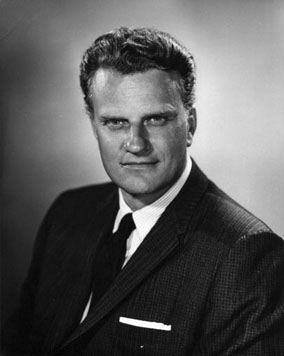
Unfortunately for our purposes, Marsden’s exploration of the Evangelical identity (beyond his five characteristics) is tied mostly to a believer’s relationship with Billy Graham. Graham is an important figure in Evangelical Christianity, but his influence has been diminished in recent years due to his age, and a marked move in Evangelicalism toward Conservatism.
Before we attempt to explain the trending toward Conservatism amongst the larger Evangelical community, it is necessary to explore the Evangelical attitude toward community engagement. Outside of experiential piety, the Evangelical relationship with society at large is probably the most defining characteristic of the movement.
The one thing that all Evangelicals share, regardless of political or theological leanings, is a pronounced outspokenness. All Evangelicals believe that the gospel is alive and has a purpose in the community. Different stripes of Evangelicalism can be delineated by what they believe the purpose of the gospel to be. Oftentimes, this manifests itself through political or social action. Conservative Evangelicals tend to focus on moral issues related to “family values.” Abortion and gay marriage are the two most prominent conservative Evangelical causes. Liberal Evangelicals tend to emphasize moral issues at the societal level, focusing on social justice, environmentalism, and institutional violence.
In this sense, Evangelicals are almost defined more by their relationship with society as a whole than by any belief that they may have. Certain beliefs may precipitate certain actions, but for one to be an Evangelical in the sense we are trying to capture, one must be seen.
The confluence of these factors leads me to define an American Evangelical as – an American Protestant who believes that the Christian gospel has a role in dictating social policy and acts on that belief in a manner that is visible to society at large.
This is what separates Evangelicalism as an ethos from Evangelicalism as an identity – visibility. Your local Black church or Mennonite congregation may share an Evangelical ethos with the parishioners at Saddleback Church, but only one of those churches is pastored by a best-selling author.
When one shifts the Evangelical frame from what they believe to what they do, the phenomenon of conservative Evangelicalism becomes easier to deal with. Rather than viewing this as an Evangelical movement, one should view it as a movement within Evangelicalism. By separating conservatism from Evangelicalism, the scholar can evaluate conservative Evangelicalism on its own, perhaps assigned it its own category, as this author is inclined to do, preferring to refer to conservative Evangelicals as Neo-Fundamentalists – as they occupy the same cultural niche as their Fundamentalist forefathers.
By simplifying and reframing the question, tackling the issue of the identity of American Evangelicals ceases to be a monstrous and loathsome task, and instead becomes an exercise in categorizing. The scholar can then observe each phenomenon in turn, and apply whatever criticism she or he deems relevant.

No comments:
Post a Comment